

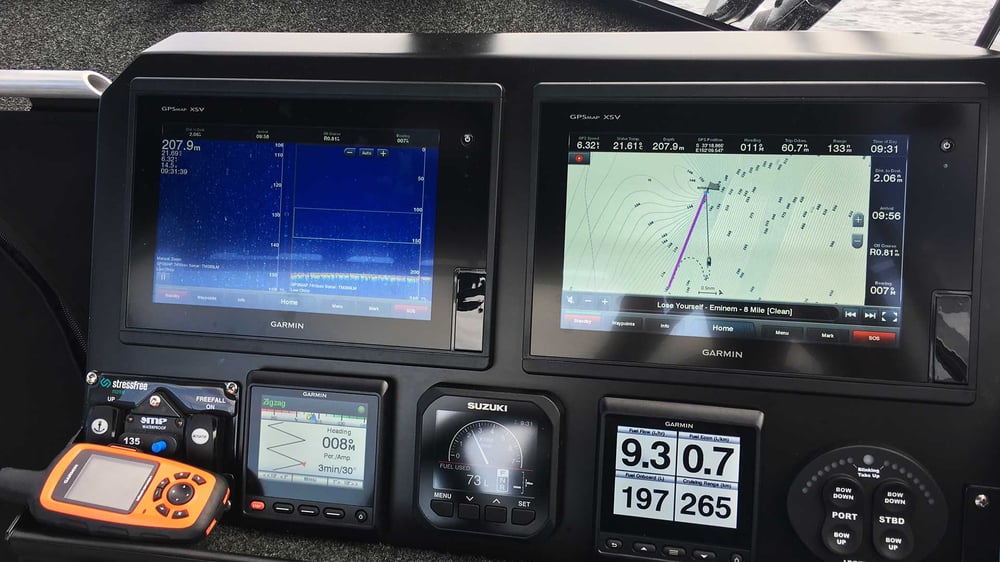
 Modern trailerboats are more advanced than ever. With high-performance hulls, precision steering, and integrated electronics, today's fishing boats are built for serious offshore and coastal work. One technology that's increasingly transforming the way anglers operate their boats is the use of autopilots in trailerboats...
Once considered a luxury reserved for larger vessels, autopilot systems are now commonplace in high-quality trailerable fishing boats. Yet many boat owners still ask: How does a boat autopilot work? Do I really need an autopilot for fishing boat use?
At Bar Crusher, our boats are engineered for serious offshore performance. Adding an autopilot for fishing boat setups enhances control, safety, and efficiency, especially when conditions demand precision. If you've ever wondered how a boat autopilot works and whether it's worth the investment, this guide breaks it down clearly.
What are autopilots in trailerboats?
Autopilots in trailerboats are electronic steering systems that automatically control the boat's heading without constant manual input. Instead of holding the wheel for long runs or constantly correcting heading while trolling lures or livebaits, the system uses sensors and hydraulic steering integration to maintain a chosen course.
For offshore anglers using Bar Crusher boats, autopilot systems offer hands-free directional control, allowing skippers to focus on navigation, radar and sounder readings, fishing preparation or watching the spread.
Modern autopilot technology has become compact, reliable, and highly accurate, making it ideal for trailerable offshore boats.
How does a boat autopilot work?
Understanding how a boat autopilot works begins with three core components:
1. Holding Sensor (Compass or Gyro)
The system continuously monitors your boat's heading. Modern autopilots sense even the slightest deviations using solid-state sensors or gyroscopes.
2. Control Computer
The autopilot computer uses the heading data and compares it with the chosen course. In the event the boat is waylaid by wind, swell, or any other factors, it computes corrective steering input.
3. Steering Actuator
The actuator (hydraulic pump or electric motor) literally rotates the engine or steering system to get the boat back on track.
In simple terms:
Autopilot sensors go dead → computes the correction to automatically turn the steering wheel.
This loop is executed several times per second and keeps the heading steady even in a changing sea environment.
Reason behind the increasing popularity of autopilots in trailerboats
Trailerboats, especially plate aluminium offshore fishing boats, are able to venture further offshore in search of marlin, tuna and other game fish. This has led to a rapid increase in demand for autopilots on trailerboats.
Key reasons include:
• Less driver fatigue during long runs
• Better crosswind keeping
• Trolling patterns are more precise
• Single-handed operation is easier
Why autopilots in fishing boats are a good idea
Success in gamefishing often requires precise boat positioning and handling. During or long offshore run and while trolling, a consistent heading is essential.
A fishing boat autopilot has several benefits:
1. Precision trolling
The autopilot is used to keep the headings precisely along the contour lines or the edges of the shelf, canyon, reef or other structure. This helps to ensure uniform lure delivery through a structured trolling pattern and often delivers an increased strike rate.
2. Better rough-water tracking
In confused swell and chop, the autopilot also corrects the steering at a lower rate than a human operator, eliminating unwanted off-course movement.
3. Hands-free navigation
Allows the skipper to:
• Monitor electronics
• Rig tackle
• Assist crew
• Focus on hazard scanning
This is particularly helpful when travelling alone or with short crews.
Do autopilots in trailerboats affect fuel efficiency?
Yes… in a positive way. Consistent steering reduces unnecessary throttle fluctuations and erratic course changes.
When a boat tracks cleanly, it:
• Maintains optimal RPM
• Reduces steering drag
• Improves fuel burn consistency
For offshore anglers covering long distances, fuel efficiency matters.
Bar Crusher Integration: The ‘Fishing Weapon’ Advantage
Why does an autopilot work so well on a Bar Crusher? It comes down to our hull geometry.
Because of the Waveslicer deep-V entry, our boats track incredibly straight. Flatter hull boats tend to wander or ‘hunt’ in a following sea, which forces an autopilot to work overtime, causing the pump to cycle constantly.
A Bar Crusher's hull provides the directional stability that allows the autopilot to make fewer, smaller corrections.
Installation considerations for Bar Crusher boats:
When adding an autopilot to a Bar Crusher, consider:
• Compatibility with hydraulic steering
• Integration with existing GPS and sounder units
• Helm space for control displays
• Power supply capacity
Bar Crusher's thoughtful and spacious helm layouts and offshore-ready design make integration straightforward.
Consult with qualified marine electronics installers to ensure correct calibration and setup.
Final thoughts
Autopilots in trailerboats have evolved from luxury add-ons to essential offshore tools for serious anglers. An autopilot improves safety, efficiency, and precision.
If you've been wondering how a boat autopilot works, the answer is simple: it combines GPS data, heading sensors, and steering integration to hold your course with constant micro-adjustments.
When paired with Bar Crusher's offshore-capable hull design, autopilot technology enhances boat control, freeing you to focus on what matters most: finding and catching fish.
Frequently Asked Questions
1. How does a boat autopilot work on a trailerboat?
It uses a heading sensor and GPS to monitor direction, then automatically adjusts hydraulic steering through an actuator to maintain a selected course.
2. Are autopilots in trailerboats reliable offshore?
Yes. Modern systems are highly reliable when installed correctly and properly calibrated for offshore conditions.
3. Is an autopilot for fishing boat use worth it?
Absolutely. It improves trolling accuracy, reduces fatigue, enhances safety, and allows hands-free navigation during long runs.
4. Can an autopilot be added to an older Bar Crusher boat?
Yes. Most Bar Crusher boats with hydraulic steering systems can be fitted with modern autopilot systems with professional installation.
5. Does an autopilot replace the skipper?
No. Autopilots assist with steering but require constant supervision. The skipper remains responsible for navigation and safety at all times.


