

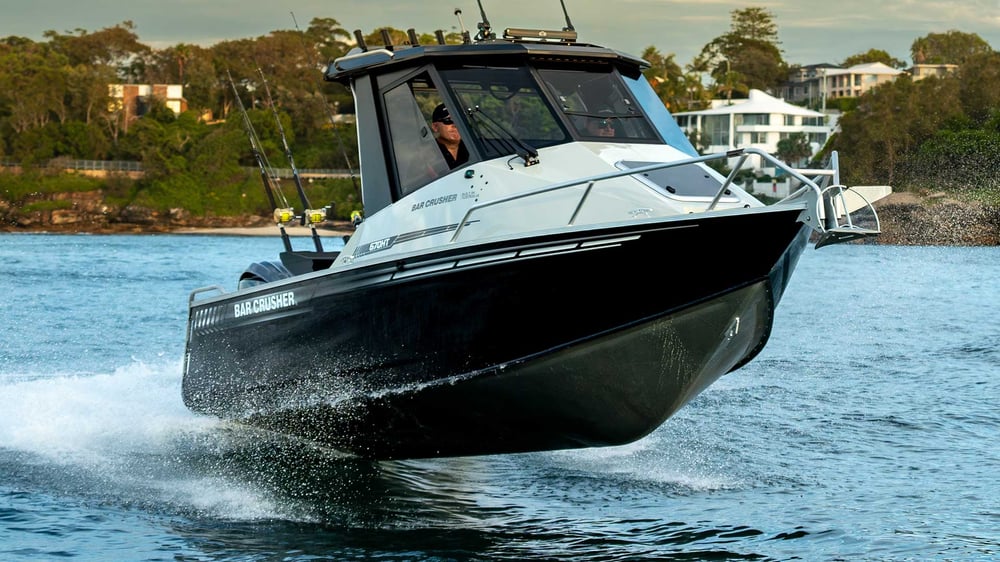
 When you’re miles offshore, and the swell starts building, hull design stops being a technical detail and becomes the single most important factor influencing safety and performance. Stability at rest, comfort in chop, fuel efficiency, and overall confidence on the water all come back to one core element: fishing boat hull design...
At Bar Crusher, we understand choosing the right hull is critical. If you’re currently researching fishing boats for sale or comparing options from reputable custom boat builders, understanding how hull geometry affects performance will help you make a smarter, long-term decision.
Let’s break down why hull design matters and how to choose the most stable fishing boat for your needs.
Why hull design is the foundation of stability
Every boat floats. Not every boat performs confidently when conditions turn challenging.
The most stable boat hull design must deliver:
• Predictable offshore handling
• Strong lateral stability at rest
• Smooth wave entry
• Balanced weight distribution
• Structural integrity under load
At Bar Crusher, our hulls are purpose-built for Australian conditions. Stability is not accidental. It is engineered.
Understanding fishing boat hull types
You must know the various types of hulls of fishing boats in the market before deciding on the appropriate vessel.
1. Deep-V hull
• Sharp entry angle
• Deep deadrise
• Reduced pounding in chop
• Superior comfort in swell
• All-round good offshore performance
This is the most commonly recognised boat hull design for offshore fishing. The deep-V construction of Bar Crusher boats, made of plate aluminium, provides strength, performance and confidence when the sea becomes unpredictable.
2. Modified-V hull
• Moderate deadrise
• Well-rounded inshore capability
• Fairly good performance in medium chop
The practical alternative for bays and closed coastal waters; for anglers who rarely venture offshore.
3. Flat-bottom Hull
• Very stable in flat water
• Shallow deadrise
• Ideal for rivers, lakes and estuaries
• Poor offshore ability
Flat-bottom boats are not ideal for offshore conditions.
Offshore performance v/s inshore stability
Selecting the appropriate fishing boat hull design is based on the fishing environment.
If you do a lot of offshore fishing, make sure you choose a boat with:
• A deep-V hull
• Is constructed from heavy-duty aluminium plate, rather than pressed aluminium
• Has a reinforced transom
• High freeboard for safety
Bar Crusher boats have been developed for offshore conditions and are very durable.
Beam v/s stability in the real world
It is a common mistake among buyers to think wider boats are always more stable. Beam helps to provide stability, but this is not the whole pie, but a wider beam for a given length results in pounding… it’s why the world’s fastest racing yachts are long and narrow.
True stability depends on:
• Hull weight distribution
• Structural rigidity
• Centre of gravity
• Fuel tank placement
• Water-ballast technology
The most stable boat hull design for offshore conditions incorporates all these factors.
Stability at rest: why anglers value it
While offshore ride comfort matters, stability at rest is equally important.
A stable hull allows:
• Confident fish fighting
• Multiple anglers to move around freely
• Safer lure casting
• Reduced roll in swell
Deep-V designs, when engineered correctly, can deliver both offshore penetration and impressive lateral stability, a hallmark of advanced fishing boat hull design. Bar Crusher’s well-proven combination of Waveslicer hull and Quickflow water-ballast system is case in point.
Choosing the right hull for your fishing style
Ask yourself:
• Do I regularly fish offshore?
• How far do I travel out to sea?
• Do I prioritise ride comfort?
If versatility is your goal, selecting a well-designed and built deep-V plate aluminium hull often delivers the most stable boat hull for both offshore and inshore use.
For buyers exploring hardtop boats for sale, enclosed configurations provide additional protection while retaining hull performance.
Meanwhile, anglers considering bowrider boats for sale in Australia should carefully assess whether the hull design matches offshore demands.
Final thoughts
Hull design determines everything from safety and ride comfort to fuel efficiency and resale value.
Understanding different fishing boat hull types allows you to compare vessels confidently. Whether browsing listings or evaluating models from leading boat builders, always prioritise structural integrity and engineered performance.
The most stable boat hull design is not simply the widest hull or the fastest boat. It is the one engineered for your fishing conditions, built with heavy-duty materials, and designed to handle real-world offshore demands.
At Bar Crusher, hull performance is engineered based on real-world experience; not guessed. When conditions change, the right hull makes all the difference.
Frequently Asked Questions
1. How does hull shape affect boat performance and stability?
Hull shape influences how a boat cuts through waves, how stable it remains at rest, and how it responds to turning forces. Deep-V hulls provide better offshore comfort, while flatter hulls improve calm-water stability.
2. What factors should I consider when choosing a hull design for fishing?
Consider your primary fishing environment, expected sea conditions, required fuel range, passenger load, and how important ride comfort is in rough water.
3. Are wider boats always more stable?
Not always. Beam width contributes to stability, but hull angle, deadrise, structural design, and weight distribution play equally important roles, as does water ballast technology.
4. Which hull type is best for both calm and rough water?
A well-engineered deep-V plate aluminium hull with water ballast typically provides the best balance between offshore performance and stability.on.
5. Can hull design impact fuel efficiency and speed?
Yes. Efficient hull design reduces drag and improves planning, directly affecting fuel consumption and overall speed.


